Skip to content


The global business scene keeps on evolving, and with it, the rules for success! For any business to be able to compete in the current market, it needs to reach its target audience in the most convenient ways for them, and there is nothing more convenient than making your business feel authentic and native to your targeted markets.
This is why the content localization services have been a game-changer for many global business tycoons like Netflix, Coca-Cola, and many more! But what exactly are the content localization services, and why does your business need them?
In this article, we dive into content localization services, their best practices, their impact on businesses and more!
What Are Content Localization Services
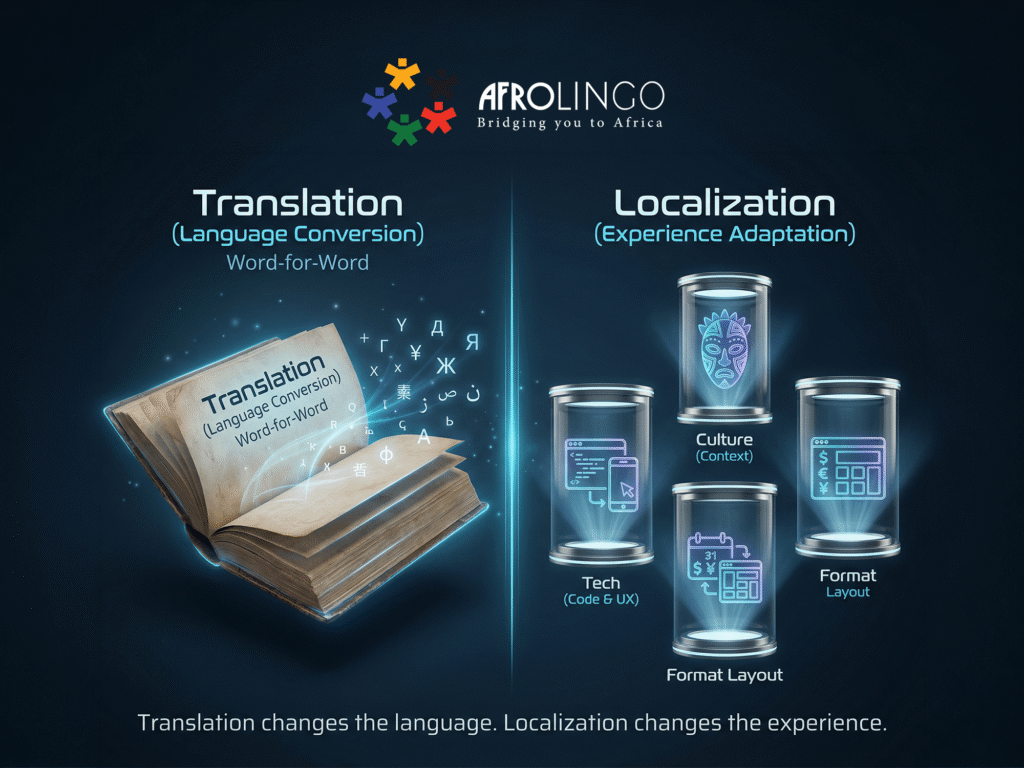
Content localization services go way beyond swapping English words for other ones. While translation handles language conversion, localization adapts your entire experience, so it genuinely resonates with specific markets.
Content localization is the process of adapting a product, website, or piece of content to meet the language, cultural, and functional requirements of a specific target market.
Think about a software company expanding to the Middle East. Just translating button labels from English to Arabic won’t cut it.
Effective web page localization means restructuring the whole interface for right-to-left reading, switching update and currency formats, rethinking color choices that carry different cultural meanings, and adjusting features to meet regional data privacy rules. A professional content localization service provider handles all these moving parts.
While content translation and localization are often used interchangeably, they are distinct disciplines:
· Translation transforms text from Source Language A to Target Language B. It is linguistic.
· Localization (L10n) transforms the entire user experience. It is cultural and technical.
Benefits and ROI: Why Localization Drives Revenue?
With the majority of internet users now located outside of English-speaking countries, a monolingual approach effectively alienates over 70% of the global market.
Content localization services can benefit your business in many ways:
1. Increased Conversion Rates
Data from 2024-2025 indicates that 76% of online shoppers prefer to buy products with information in their native language, and 40% will never buy from websites in other languages. When users can read product descriptions, reviews, and legal terms in their mother tongue, friction disappears, and trust increases.
2. SEO Dominance and Visibility
Web page localization is critical for International SEO (ISEO). Google’s algorithms prioritize local search intent. By localizing your metadata, alt tags, and URL structures, you signal relevance to search engines in specific geographies.
- Example: A user in Nairobi searches for “best accounting software” in Swahili. If your site is only optimized for English keywords, you are invisible to this high-value query.
3. Risk Mitigation and Compliance
In regulated industries like finance, life sciences, and manufacturing, accuracy is non-negotiable. Misunderstanding a liability clause or safety instruction due to poor translation can lead to lawsuits and brand damage! Professional localization ensures compliance with local laws (such as GDPR in Europe).
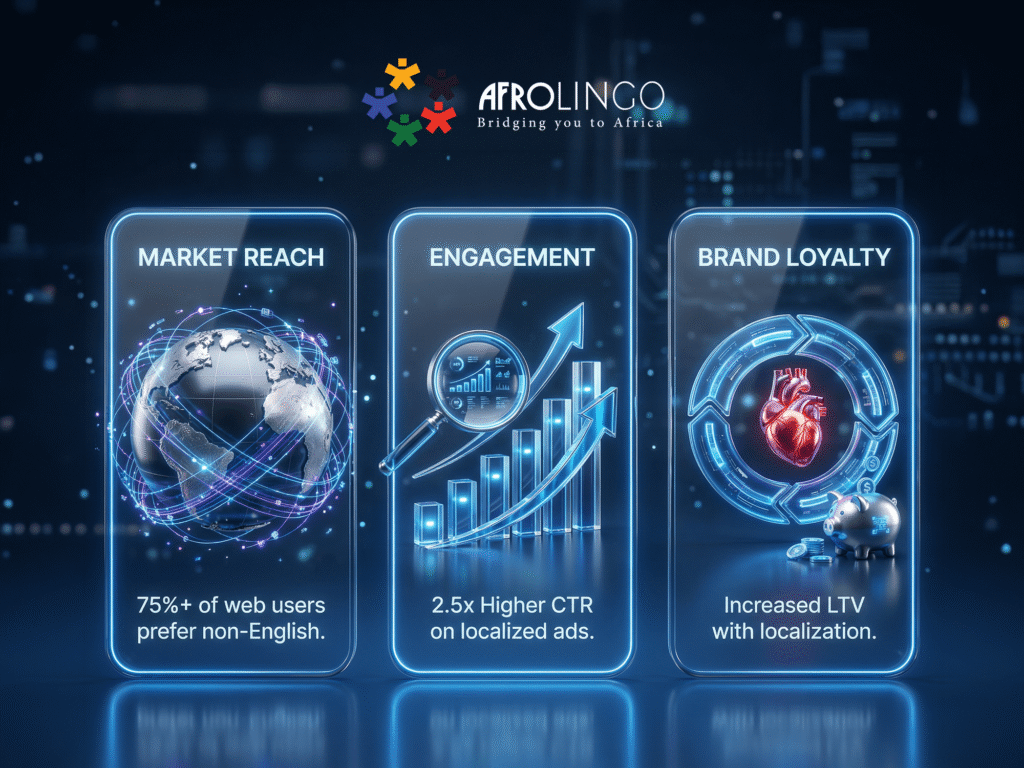
ROI Snapshot Table:
| Metric | Impact of Localization |
| Market Reach | Access to the 75%+ of web users who prefer non-English content. |
| Engagement | 2.5x higher click-through rates on localized social ads compared to generic English ads. |
| Brand Loyalty | Users perceive localized brands as “local” partners, increasing Life Time Value (LTV). |
Types of Services: Beyond Text
Any wide-ranging content localization service provider offers a suite of services tailored to different media formats. Modern audiences consume content through video, apps, and interactive courses, not just static text.
1. Web Content Localization
This is the adaptation of your digital storefront. It involves:
- Content Management Localization: Integrating your CMS (WordPress, Adobe Experience Manager, Sitecore) directly with translation tools via API to automate updates.
- UI/UX Adaptation: Resizing buttons to fit translated text and ensuring navigation makes sense for the local user flow.
2. Video Localisation
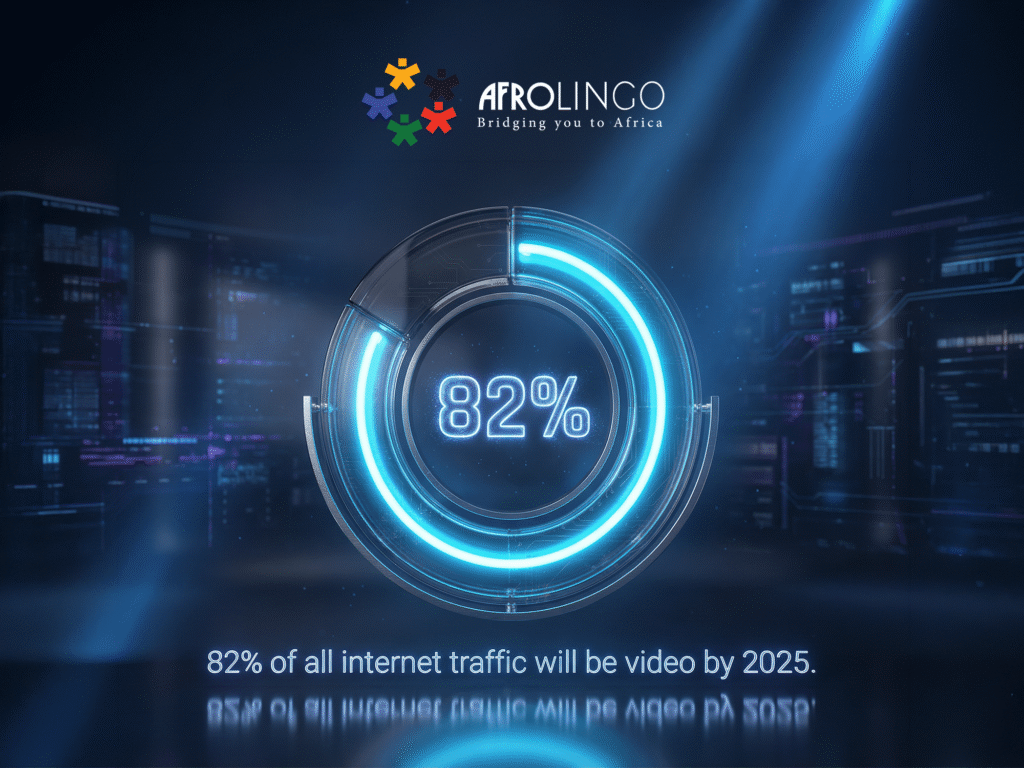
Video is predicted to account for over 82% of all internet traffic by the end of 2025. If your multimedia strategy isn’t localized, it isn’t global.
- Subtitling: Cost-effective and essential for social media (where 85% of videos are watched on mute).
- Dubbing/Voiceover: Critical for high-impact brand messaging. Using native accents drastically improves resonance and retention.
- On-Screen Text: Translating the text that appears inside the video graphics (lower thirds, titles).
3. eLearning Content Localization Service
As remote work becomes the global standard, the demand for e-learning content localization services has surged.
- Application: Multinational corporations must ensure that employees in Brazil, Japan, and France understand cybersecurity protocols, compliance standards, and soft skills training equally well. This reduces corporate liability and boosts workforce efficiency.
4. App and Software Localization
Global users expect mobile apps to feel native. Localization here focuses on string translation, App Store Optimization (ASO) for local keywords, and ensuring the app performs well on local operating system preferences.
Choosing Your Provider: A Vet-List!
Picking the right content localization service provider is one of your biggest decisions in international expansion. Not all content localization companies are created equal! Here are some aspects to consider when choosing your partner:
1. Native Linguist Policy
Does the provider use native speakers living in the target country? Language evolves rapidly (slang, tech terms, cultural references). A translator who left the country 10 years ago may use outdated terminology.
A provider claiming “French” expertise should differentiate between Parisian French and varieties spoken across Francophone Africa. “Arabic” isn’t monolithic; Moroccan Darija, Egyptian Arabic, and Sudanese Arabic require different approaches.
2. Technical Capabilities
Can they handle content management localization? Your provider should be able to connect via API to your system, eliminating the need to email Word documents back and forth. This “continuous localization” workflow is the standard in 2025.
Check providers’ translation management systems, AI translation technology, and terminology databases. Modern systems should integrate with your existing CMS while maintaining centralized translation memory, cutting costs for recurring content.
3. Subject Matter Expertise
Content localization needs vary by industry, so make sure to examine providers’ portfolios in your specific industry and target regions.
If you are in fintech, you need linguists who understand “amortization” and “blockchain.” If you are in medical devices, you need experts in “regulatory affairs.” Generalist translators will fail to capture the technical accuracy required for specialized industries.
4. Quality Assurance (QA) Process
Professional services use multi-layered frameworks to catch errors before they reach audiences. Verify providers use three-step review processes and hold certifications like ISO 17100. For African markets, ask whether they conduct in-market reviews with actual users to catch cultural norms.
Ask about their QA workflow. A standard professional process includes:
- TEP: Translation, Editing, Proofreading.
- Linguistic Testing: Reviewing the content in its final layout/context (LQA) to catch UI errors.
5. Critical Questions
Get clear answers on machine translation versus human translator percentages, cultural sensitivity review processes, backup plans for quality failures, and terminology consistency management. Request translation samples matching your content type.
If targeting African markets, specifically ask about their linguist network across the continent and experience with region-specific challenges like mobile-first optimization.
Implementation Strategy Guide
Ready to deploy? Here is a step-by-step roadmap to implement your content localization strategy without disrupting your operations.
Phase 1: Foundation and Assessment
Start with a comprehensive content inventory cataloging everything needing localization: websites, product docs, email templates, social media, support knowledge bases, training materials, mobile apps, and legal documents. Assess each category’s business impact and complexity to determine priorities.
Define target markets by evaluating market size, competitive intensity, and cultural fit. A fintech company might start with Kenya (strong mobile money adoption) and Nigeria (the largest African economy) before expanding to Ghana or South Africa.
Establish success metrics, including engagement indicators, conversion rates, customer satisfaction measures, and business outcomes. Track from pre-localization baseline through post-launch to quantify ROI.
Phase 2: Process Design
Build your content localization strategy framework, establishing roles and decision-making authorities. Implement translation memory and terminology management systems. Create comprehensive style guides covering tone, formatting, and cultural adaptation guidelines.
Select appropriate technology infrastructure, starting with a state-of-the-art translation management system.
Phase 3: Execution and Launch
Roll out pilot programs with phased launches.
- Month 1-2: localize highest-priority assets for primary target market.
- Month 3-4: expand to complete website coverage and marketing materials.
- Month 5-6: launch secondary markets using refined processes.
Coordinate across technical teams implementing hreflang tags, marketing teams adapting campaigns, sales teams training on market-specific propositions, and support teams preparing multilingual knowledge bases. For African markets, ensure mobile optimization and testing on popular local devices.
Don’t overlook the quality assurance testing, verifying linguistic accuracy, functional testing, visual inspection, and SEO validation. Consider in-market user testing in target African countries.
Phase 4: Optimization
Monitor performance metrics, tracking user behavior, conversion performance, customer satisfaction, and revenue by market. Gather qualitative feedback through user testing, advisory boards, and surveys measuring cultural resonance.
Make improvements based on insights with quarterly audits, terminology reviews, competitive analysis, and technology assessments. Scale methodically, leveraging earlier learnings while maintaining quality standards.
Conclusion
The future of global business belongs to those who know how to connect with the local customers. By leveraging content localization services, you move beyond language barriers and build genuine connections with your audience, regardless of where they are located. Whether it is through precise e-learning content localization for your global teams or high-impact video localisation for your marketing campaigns, the goal remains the same: to make your customer feel at home with your brand.
Ready to expand your reach? Contact Afrolingo today to discuss how we can tailor a localization strategy that drives growth in your target global markets.