Skip to content


There’s a moment every software team reaches, a moment where product ambition collides with the limits of a single market. It’s usually a signal: interest growing from regions you didn’t expect, support tickets coming in foreign languages, or a competitor suddenly showing up in a market you hadn’t considered yet.
And in that moment, the conversation shifts. “We need to translate our software” becomes the instinctive first reaction, but translation alone isn’t structurally enough. Because when you’re entering another linguistic and cultural ecosystem, software localization becomes the real engine behind global adoption.
This guide breaks down the software localization process the way professional localization companies execute it, structured, engineered, multi-layered, and aligned with how global products actually get built.
The Hidden Reality Behind the Software Localization Process
When teams say they’re “localizing software,” they often picture a linguistic exercise. Send the text out, get it back in another language, plug it in, ship it.
But inside professional localization companies, the software localization process looks nothing like that. It’s a coordinated operation that touches code, UX, content, compliance, and user expectations all at once.
In practice, software localization is the process of product adaptation rather than translation, because the real goal isn’t to make the interface readable; it’s to make the entire experience feel like it was engineered for that market from the start.
And that’s the part most teams don’t see at first. Translation is just one small thread. Localization is the system that rewires how the product behaves, responds, displays, formats, guides, and communicates in every locale.
| Criteria | Translation | Software Localization |
| Purpose | Converts text. | Adapts the entire product. |
| Scope | Words and meaning. | UI, UX, logic, content, visuals. |
| Depth | Linguistic only. | Functional + cultural + technical. |
| Team | Linguists. | Linguists + engineers + testers. |
| Context | Done outside the product. | Done inside real UI and flows. |
| Technical Work | Minimal. | High (layouts, formats, code). |
| Outcome | Readable content. | A product that feels native. |
Once you recognize that localization is really experience engineering, not language substitution, the next question becomes obvious: what makes that engineering possible in the first place?
That foundation is internationalization.
A Quick Glimpse Into Software Internationalization
Software internationalization is the engineering groundwork that prepares a product to support multiple languages and cultural variations before localization even begins. It’s the structural layer that decides whether localization runs smoothly or breaks the moment text expands or formats change.
Here’s what internationalization typically involves:
- Externalizing all user-facing text so nothing is hard-coded into the UI.
- Supporting Unicode and multiple encodings to handle every script.
- Designing flexible layouts that can expand, contract, or change direction.
- Making logic, formats, and validations locale-aware, from dates to currencies.
- Preparing resource files (JSON, XLIFF, XML, .properties) for scalable localization.
Pre-Localization: Strategy, Scoping, and Readiness
Market and Scope Decisions
Every professional software localization service starts before a single string gets translated. Because the biggest risks in global product releases come from poor preparation, not poor translation. The preparation phase determines scope, speed, quality, and scalability.
Teams begin by prioritizing target markets, languages, regions, compliance environments, user behaviors, and product usage patterns. They identify what needs to be localized, UI strings, support content, help articles, forms, images, error messages, multimedia, and even the workflows users step through. This is also the point where program localization requirements are mapped against platform constraints.
Engineering Readiness
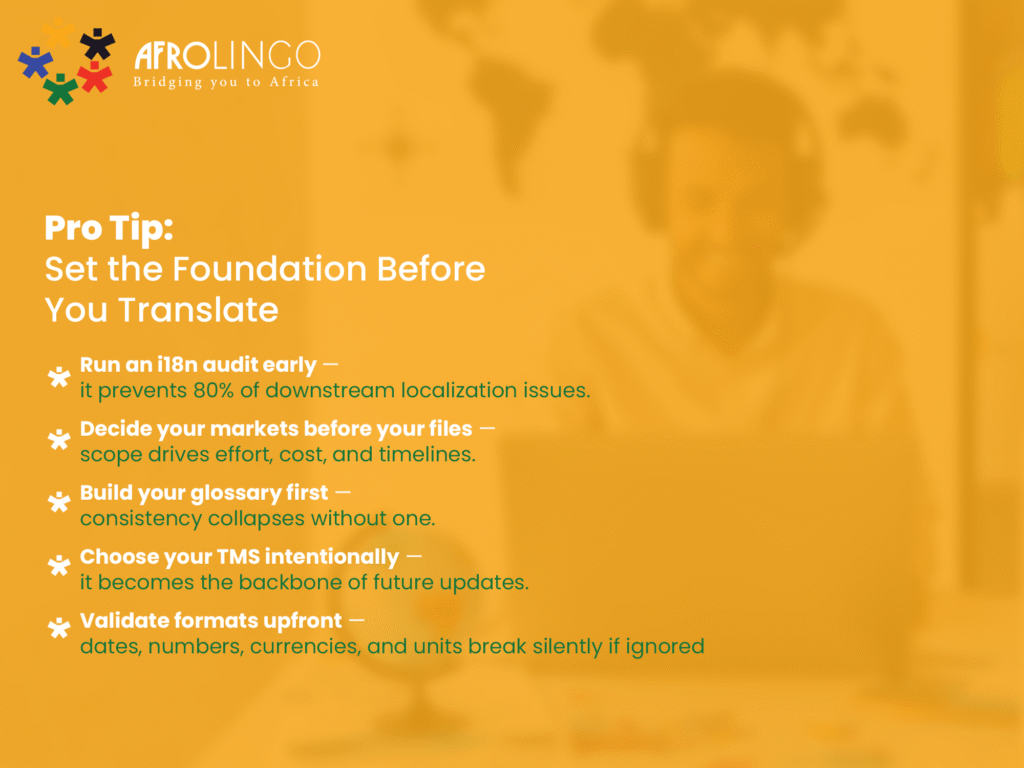
Then comes the technical foundation. Internationalization engineering sets the parameters: every string must be externalized, variables separated from text, formats standardized, and resource files structured in scalable formats like XLIFF or JSON. Products must support text expansion and contraction, right-to-left scripts, locale-aware number and currency systems, and Unicode encoding. If internationalization isn’t solved early, the product isn’t ready, no matter how skilled your translators are.
Terminology & Tools
Before localization begins, the terminology infrastructure is built. Glossaries define how key product terms should appear in every language. Style guides decide voice and tone. And for sectors like healthcare, clinical terminology alignment becomes non-negotiable.
This is also where teams choose their workflow engine, a translation management system, connectors, automation pipelines, and any integration that supports continuous development cycles.
Most companies underestimate this phase. Professionals never do. Because without this scaffolding, the software localisation process collapses under its own complexity.
Extraction, Engineering, and Content Preparation
Identifying Localizable Assets
Once the groundwork is set, the technical spine of the software localization process kicks in. This stage looks deceptively simple from the outside: export strings, send them to translators, reimport them, and push a build. But anyone who has lived through a broken build caused by a single space or missing tag knows how fragile that assumption is.
Providers start by identifying every translatable asset: UI components, dialog boxes, notifications, system messages, menus, onboarding screens, and forms. Mobile teams layer in app localization needs, ensuring parity across platforms.
Desktop products introduce their own constraints. And multimedia teams handle images, videos, and illustrations, sometimes requiring indesign localization when text is embedded into design files.
Context Preservation
Context becomes a primary currency. Translators can’t make accurate decisions without screenshots, developer notes, user flow descriptions, and functional behaviors. And when context is missing, quality drops fast.
Early Validation
Professional ocalization engineers run pseudolocalization early. They artificially expand text, inject accent marks, and simulate foreign characters to reveal what will break. A cramped button. A misaligned modal. A form that fails when labels stretch.
Pseudolocalization Can Save You Weeks Later
- Run it early to expose expansion, directionality, and layout issues.
- Treat every break as a signal, not a setback.
- Fixing structural issues now protects every future language.
Engineers clean files, validate placeholders, resolve legacy encoding, and standardize structure. And once everything is ready, the content enters the linguistic engine: translation, review, and in-context validation. But translation itself? That’s just one piece of the system.

Translation and Linguistic Execution
Expert-Led Translation Workflows
This stage is where linguistic expertise meets technical rigor. Professional software localization translation teams operate under strict parameters: accuracy, clarity, context relevance, and functional correctness.
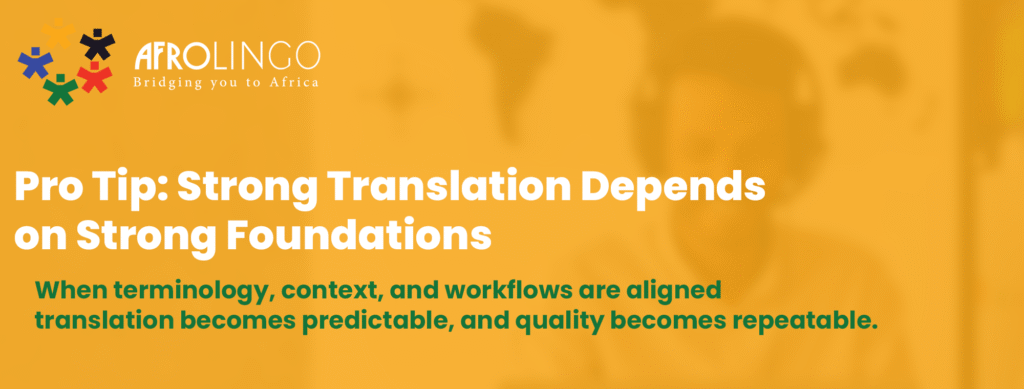
They use translation memory to maintain consistency across versions and reduce future cost. They rely on glossaries to stabilize terminology. And they work inside a translation management system to ensure version control, traceability, and workflow visibility.
Domain Expertise
Native linguists handle the core translation. Domain specialists step in for technical areas, especially in industries like finance, cybersecurity, engineering, and medical software localization. Context reviewers then validate everything inside the interface, not on a spreadsheet. Because that’s the only place where linguistic meaning and functional behavior actually meet.
Integrated Review
This is also where software localization and translation workflows merge. Translators modify phrasing to fit UI boundaries. Reviewers adjust strings to preserve clarity. Engineers step in when text causes structural issues.
And by the time the content re-enters the product, it has passed through multiple verification layers, not because localization companies are slow, but because software breaks easily, and users judge instantly.
Integration, Build, and Functional Alignment
Reintegration
Once linguistic work is complete, a new cycle begins: integrating localized content back into the software. This is where layout issues emerge, functional inconsistencies show, and edge-case bugs appear. Buttons stretch. Forms misalign. Dropdowns overflow. A single missing variable placeholder breaks a workflow.
Functional Consistency Checks
Integration isn’t just about placing translated text into a build. It’s about ensuring the localized software behaves like the source product. Engineering teams merge branches, test builds, coordinate versions, and run regression checks across every locale. And because global users expect synchronized releases, this stage often determines whether localization supports or slows down a team’s development velocity.
Special Sector Considerations
If a product is designed for speed, continuous integration becomes a dependency. If the product is complex, manual oversight becomes a requirement. And if it’s heavily regulated, such as in medical software, validation becomes mandatory.

QA, Testing, and Compliance
Multi-Layered QA
This is the phase where product teams discover whether the software localization process actually worked. Testing is where everything becomes visible: the quality, the gaps, the assumptions, and the strengths of internationalization decisions. And unlike typical QA, localization testing has to validate both language and functionality.
Professional teams use a multi-layer testing model:
• Linguistic QA: correctness, tone, clarity, consistency
• Functional QA: does the software actually work in each language?
• Cosmetic QA: layout, spacing, overflow, alignment
• Compatibility QA: devices, platforms, screen sizes, OS variations**
Cultural and Script Sensitivity
Right-to-left languages add spacing and alignment challenges. Languages like Finnish and German cause expansion issues. Asian languages introduce their own spacing and line-break rules. And culturally sensitive markets bring nuance into visuals, symbols, workflow behaviors, and even color choices.
Regulated Environments
For regulated industries, quality goes beyond QA. Medical software localization requires domain reviewers, terminology audits, compliance checks, and full traceability for regulatory filings. It’s not optional. It’s structural.
By the time software passes this stage, it’s not just translated. It’s validated.
Release, Maintenance, and Continuous Localization
Global Release Cycle
Most companies believe localization ends at release. Providers know release is the midpoint.
Once a product goes live in multiple languages, the operational burden expands instantly.
Every new feature, every line of code, and every updated label now has to be translated, reviewed, integrated, tested, and released across every active locale.
That’s why continuous localization has become the default model for global-ready software: it’s the only way to keep all versions aligned without slowing product delivery.
Automation and Workflow Synchronization
Automation plays a central role here. Modern systems detect new strings the moment they appear, push them into a TMS, route them to reviewers, and pull them back into the codebase with minimal friction. This keeps localization synchronized with development cycles, especially in agile environments where updates ship weekly or daily.
Governance and Scalability
As release cycles accelerate, governance becomes non-negotiable. Localization only stays stable when someone owns the operation and the rules guiding it. At this stage, teams usually anchor their efforts around three core pillars:

Clear Ownership
- A dedicated owner for software localization management
- Accountability for terminology updates and linguistic consistency
- Oversight of vendor communication and workflow coordination
- Control over bug triage across all locales
Strategic Vendor Selection
- Providers differ not in basic capability but in specialization
- Some excel in high-volume, fast-turnaround environments
- Others support multimedia-heavy or design-heavy products
- Certain vendors specialize in domain-intensive sectors such as healthcare or cybersecurity
- Choosing the best software localization companies determines how efficiently a product can scale from one market to ten
Institutionalized Best Practices
- Mature teams rely on proven software localization best practices
- Structured workflows and clear terminology governance
- Automation integrated directly into development cycles
- Proactive QA to prevent late-stage failures
- Processes designed to ensure speed, consistency, and cross-market stability
When localization reaches this stage, it stops being a task and evolves into a scalable operating system, one capable of supporting sustained global growth.
Conclusion: Turning Localization into a Growth Engine
By the time a company completes its first multilingual release, a deeper truth becomes visible: the software localization process isn’t a service you purchase. It’s an infrastructure decision. A global strategy. A long-term system for scaling experience, culture, and usability across markets.
And that system needs intention.
If you want actionable steps to start strengthening your process today, here are the non-negotiables:
• Audit your internationalization now, not later. Most failures begin here.
• Build your glossary and style guides before translation, not during.
• Run pseudolocalization early. It will expose what would break later.
• Treat testing as a core phase, not an afterthought.
• Plan for continuous localization the moment you plan for global releases.
And if you’re looking for a partner who understands the operational, technical, and cultural demands of global expansion, AfroLingo can support you with a software localization process built for precision, speed, and scale.
FAQ
What is the software localization process?
The software localization process is the structured system of adapting a digital product—its UI, content, logic, formatting, visuals, and compliance requirements—to meet the linguistic, cultural, and functional expectations of a specific market. It ensures the software feels like it was engineered locally, not translated after the fact.
What is a localization process?
A localization process is the end-to-end workflow that prepares, adapts, tests, and releases a product for different regions. It includes internationalization, content extraction, translation, engineering adjustments, QA, integration, and continuous updates to ensure the product works correctly in every target locale.
What is an example of software localization?
A simple example is transforming a U.S. banking app for use in Saudi Arabia: translating the UI, adjusting number and date formats, supporting right-to-left Arabic layout, adapting onboarding steps to local norms, replacing images and icons where needed, and ensuring the product complies with regional financial regulations. The result is an app that looks, feels, and behaves natively for Saudi users.
What is the localization process flow?
A typical localization process flow includes:
Internationalization readiness
Content extraction and engineering preparation
Translation and in-context review
Integration into the product
Linguistic, functional, and UX testing
Release and continuous localization for future updates
This flow ensures every market receives a fully functional, culturally aligned version of the product.