Skip to content


Nelson Mandela once said, “If you talk to a man in a language he understands, that goes to his head. If you talk to him in his language, that goes to his heart.” That’s exactly what brand localization is about.
Brand localization is what turns a brand from being overlooked into one that truly connects. And this brings us to the real question: how can your brand stay true to its global identity while resonating locally?
In this blog, we’ll reveal how to master brand localization so your brand doesn’t just enter markets; it’ll dominate them.
What Is Brand Localization and Why Does it Matter?
Expanding globally requires more than just reach; it requires resonance. Many business leaders fall into the trap of thinking translation alone is enough to capture a new market. While translation converts words, it fails to capture the cultural and emotional nuances that make a brand feel native.
Translation vs. Localization: The Strategic Difference
While translation converts text from one language to another, localization adapts the entire brand experience to fit a specific market. Translation focuses on words; localization considers culture, visuals, tone, UX, product features, and even local regulations.
In other words, translation tells your audience what you mean — localization makes them feel it. It’s this emotional and cultural alignment that drives engagement, loyalty, and sales across global markets.
So, why is it important?
Brand localization shapes messaging, visuals, product experience, and identity so your brand feels native rather than foreign. A well-localized brand speaks the way people talk, respects local values, and fits seamlessly into daily life. Done thoughtfully, it transforms a brand from an unfamiliar outsider into a trusted choice.
Let’s have a look at the numbers: 72% of consumers prefer buying in their native language, 40% won’t purchase from brands that don’t offer localized content, and 56.2% consider access to information in their language more important than price. These figures show that localization doesn’t just aid comprehension; it builds trust, engagement, and conversion.

Mango Campaign Gone Wrong
Consider the 2013 misstep by fashion giant Mango; when launching a jewelry line in France and the UK, they relied on a literal translation of the Spanish word “esclava,” which refers to a bangle or ID bracelet.
And because they translated the word without localizing the context, they translated the product description word-for-word into French and English. The collection was released as “Slave Style” jewelry.
The backlash was immediate, triggering a PR crisis that branded the brand as culturally insensitive. Whilst a localization strategy would have caught the nuance immediately, literal translation created a reputational disaster.

What Drives a Brand Localization: Culture and Consumer Behavior
Think about how you interpret a message. You filter it through your values, your sense of humor, and your everyday reality. Your customers do the same. This cultural lens shapes whether they see your brand as a trusted partner or an outsider. For a brand to grow across markets, two forces matter most: culture and consumer behavior.
Culture Shapes Perception and Trust
Culture quietly shapes every layer of communication, influencing not just what we say but how people interpret it. The meanings audiences attach to humor, symbols, colors, and tone aren’t universal—they’re culturally constructed.
A color that sparks excitement in one region may trigger hesitation in another; red, for example, is associated with joy and prosperity in China but often signals danger or urgency in Western contexts. The same variability applies to humor and imagery. A joke that feels lighthearted and clever in one culture can seem confusing—or even disrespectful—elsewhere.
When content aligns with local norms and expectations, audiences engage more naturally because the experience feels intuitive rather than foreign. Companies that get this right see measurable returns—culturally adapted content can lift engagement by up to 30%.

Consumer Behavior Drives Engagement and Loyalty
The way people shop tells you more than what they buy. It shows you why they choose one brand over another, what reassures them, and what makes them return. Every market has its own rhythm.
In places where mobile leads, such as many African regions, people expect quick page load times, simple payment options, and content that works comfortably on a small screen. In other markets, decisions lean more on community influence or familiar retail habits.
When a brand aligns with these patterns, the experience feels natural, and customers stay with it because it fits the way they already live and decide.
Brand Localization Example Done Right

Coca-Cola personalized its famous “Share a Coke” campaign in Australia by replacing logos with common first names, boosting sales by over 4%. In China, the campaign used popular nicknames such as “Classmate” and “Sweetheart,” reflecting social relationships and collectivist culture and driving strong social media engagement.
This example clearly shows that when a brand reflects its audience’s world, consumers feel understood, driving loyalty, repeat purchases, and long-term trust.
Brand Asset Localization: Turning Touchpoints into Trustpoints
Every interaction a customer has with your brand—whether a product page, a support email, an onboarding flow, or a social ad—is a moment of truth. In global markets, these touchpoints shape perception and silently signal whether a brand understands its audience or is merely speaking at them. Brand asset localization is how companies turn these everyday interactions into trust-building moments that feel native, intuitive, and culturally aligned.
Brand Assets to Localize
1. Core Brand & Messaging Assets
- Brand tagline and slogans
- Mission, vision, and value statements
- Brand voice and tone guidelines
- Style guides, glossaries, and terminology banks
- Brand storytelling and origin narratives
2. Marketing & Advertising Assets
- Website content and landing pages
- Digital ads (display, social, video, PPC)
- Social media posts and content calendars
- Email marketing campaigns and automation sequences
- Brochures, one-pagers, and sales decks
- Press releases and PR messaging
- Case studies, white papers, and thought leadership content
- Content marketing articles, blogs, and gated assets
3. Product & UX Assets
- User interface (UI) text and microcopy
- In-app messages and notifications
- User onboarding flows
- Help center knowledge bases
- Chatbot scripts and virtual assistant responses
- Error messages and system prompts
- Product tutorials and onboarding videos
- App Store descriptions and feature lists
4. Customer Experience & Support Assets
- Customer support scripts and workflows
- FAQs and troubleshooting guides
- Warranty information
- Service agreements and SLAs
- Automated support emails and ticket responses
5. Commercial & Sales Assets
- Sales playbooks and pitch decks
- Product catalogs
- Pricing pages and promotional materials
- Contracts, proposals, and commercial terms
- RFP/RFQ responses
6. Legal & Compliance Assets
- Terms & Conditions
- Privacy policies
- Consent forms and permissions
- Regulatory disclaimers
- Licensing information
- Safety warnings and product usage instructions
7. Packaging, Labeling & Physical Materials
- Packaging copy and layout
- Labels and product inserts
- Store signage and POS materials
- Manuals and installation guides
8. Multimedia & Visual Assets
- Video subtitles and voiceovers
- Social videos and brand films
- Infographics and charts
- Visual metaphors and iconography
- Imagery that may require cultural adaptation
9. Internal & Operational Assets (Often Overlooked)
- Internal training materials
- HR documentation
- Corporate communications
- Employee onboarding content
- Internal software tools and dashboards
Spotify is a striking example of brand localization in action: by tailoring its UI, visuals, and featured artists for different regions, it had 696 million monthly active users worldwide as of mid‑2025. Spotify’s example shows that adapting brand visuals, rather than reusing global assets, boosts ROI while keeping the brand recognizable and locally relevant.

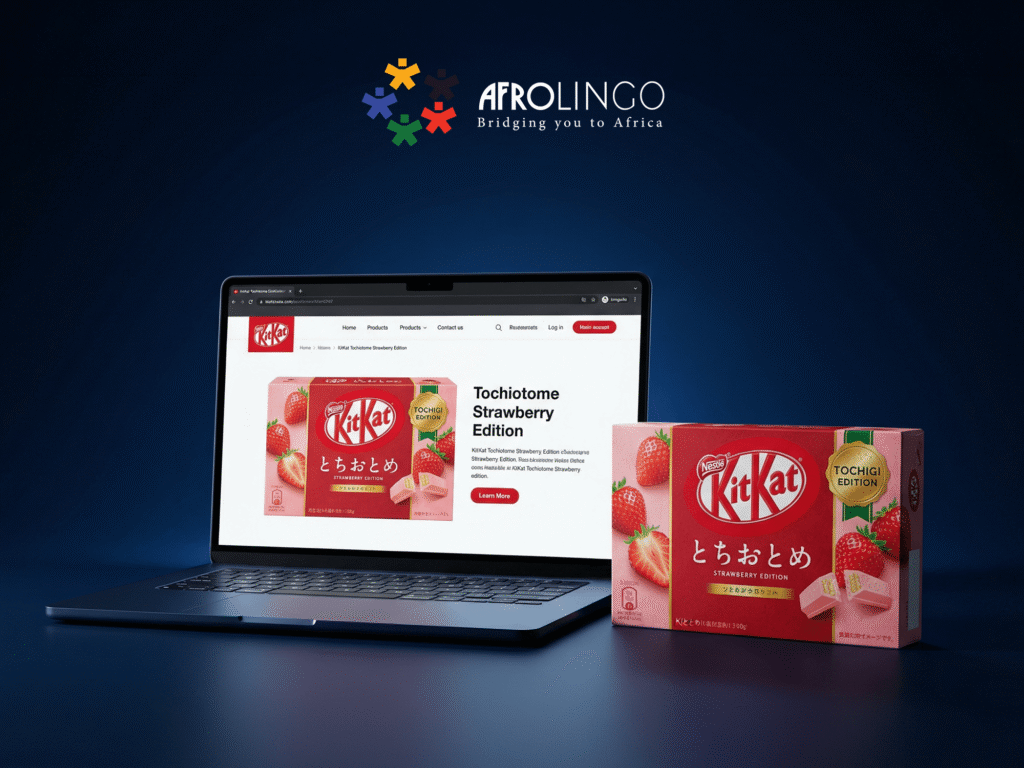
When it comes to product and UX adaptation, Nestlé, in Japan, recognized the phonetic link between KitKat and “kitto katsu,” a phrase tied to encouragement and good fortune, and built the product into traditions of luck and gift-giving. It also introduced region-specific flavours, many of which were sold only in select areas and cultural settings.
Brand localization should maintain a consistent voice while adapting tone to local communication styles, allowing messages to feel natural without losing their core character. McDonald’s, for example, balances global identity with local adaptation, offering staples like the Big Mac alongside region-specific items such as Texas’s Lone Star Stack. All while the voice remains unified, yet the delivery still reflects the local expectations.
Key Elements of a Brand Localization Strategy
Now that we’ve gained an in-depth view of brand localization and seen how top global companies leveraged it to maximize ROI, let’s explore the key points that underpin an effective localization strategy.
- Local Market Research & Cultural Insight
Effective brand localization begins long before translation—it starts with understanding how people think, buy, search, socialize, and make decisions within a specific culture. This strategy involves researching local consumer psychology, cultural norms, symbolic meanings, tone preferences, decision triggers, and category expectations. Brands use these insights to shape messaging frameworks, product narratives, imagery choices, and UX flows that feel intuitive rather than imported. Localization becomes significantly more successful when the brand adapts to the market’s worldview instead of assuming universality.
- Conduct qualitative research (focus groups, social listening, local interviews) to understand cultural motivations and emotional triggers.
- Map cultural communication norms—formality, humor, directness, symbolism—to guide tone and creative choices.
- Identify regional taboos, sensitivities, and regulatory constraints that may influence messaging or visuals.
- Benchmark local category leaders to understand narrative structures and value propositions that resonate.
- Validate assumptions with in-market reviewers early to avoid costly redesigns or misaligned campaigns
- Regulatory-Compliant Messaging & Market-Specific Adaptation
In many industries—finance, healthcare, automotive, eCommerce, and consumer tech—brand localization is a compliance exercise. Each market has its own rules governing claims, disclosures, product descriptions, data privacy language, safety instructions, advertising standards, and consumer protection requirements.
A compliant localization strategy ensures that every adapted message meets local regulatory expectations without compromising brand integrity. This includes reworking phrasing to avoid prohibited claims, adjusting tone to meet legal communication norms, restructuring product descriptions for mandated information, and aligning visual or UX elements with market-specific guidelines. When done well, compliance becomes a trust builder: customers perceive the brand as responsible, transparent, and aligned with local standards—turning accuracy into credibility.
For instance, brands must comply with local packaging and labeling regulations. For example, in the European Union, pre‑packed foods are required to include a full nutrition declaration on their packaging. And that doesn’t just stay in the food industry.
- Audit each market’s advertising laws, mandatory disclosures, sector-specific terminology requirements, and restricted claims.
- Localize high-risk assets (e.g., legal copy, financial disclaimers, product warnings) with certified linguists trained in regulatory context.
- Adapt tone and phrasing to align with regulatory expectations—for example, more cautionary language in healthcare or more precise terminology in finance.
- Review visual assets, icons, and UX patterns to ensure they comply with local guidelines (e.g., privacy consent flows, food labeling rules).
- Implement a compliance review layer in the localization workflow, involving legal and regulatory teams before publishing.
- AI-Driven Brand Localization Strategies for 2025 and 2026
By 2026, leading brands are integrating AI not as a translation shortcut but as a brand intelligence engine. AI models analyze market sentiment, test cultural framing, predict tone fit, and detect inconsistencies across global assets. Generative AI supports scalable variant creation, UX microcopy experimentation, and real-time adaptation of brand assets across markets. Meanwhile, AI-augmented QA ensures terminology, tone, and voice remain consistent across channels. The strategy is not “AI replaces translators”—it’s AI amplifies cultural precision, consistency, and speed, giving brands a competitive edge in highly dynamic markets.
One standout example is Netflix, the streaming giant, which uses AI and machine learning to personalize recommendations for each user. By analyzing viewing history and preferences, Netflix delivers content that resonates locally. This not only boosts engagement but also strengthens subscription retention and drives higher ROI.
- Leverage AI to analyze brand tone, ensure consistency, and flag deviations across thousands of global assets.
- Use LLM-powered cultural testing to predict whether localized headlines, visuals, or CTAs will resonate—or fail—in specific markets.
- Deploy AI-augmented QA to detect terminology, formatting, and compliance errors before human reviewers begin their pass.
- Integrate AI into creative workflows for scalable variant generation (e.g., social ads, product descriptions, microcopy experiments).
- Combine AI insights with human linguists to refine nuance, emotion, and cultural meaning—achieving high-trust localization at scale.
4. Cross-Channel Consistency & Brand Governance
Brand localization succeeds when the entire ecosystem—marketing, product, customer support, legal, and sales—delivers one coherent localized identity. This strategy focuses on establishing global brand governance frameworks that align terminology, tone rules, creative assets, UX patterns, and compliance expectations across teams. It includes localized style guides, market-specific glossaries, asset management workflows, and review cycles that ensure every touchpoint reinforces trust. Governance transforms localization from a series of isolated tasks into a unified brand discipline.
- Create localized style guides, tone frameworks, and terminology databases aligned with brand identity and cultural expectations.
- Use centralized asset management systems to prevent fragmentation and ensure teams access the correct localized versions.
- Establish governance roles—regional brand stewards or language leads—to oversee market-specific asset quality.
- Align product, marketing, support, and legal teams around shared guidelines to maintain message consistency across channels.
- Conduct periodic global audits to identify inconsistencies in voice, claims, UX elements, or customer-facing materials.
The Final Verdict: Localization Drives Expansion
Global expansion isn’t a matter of geography—it’s a matter of relevance. Brands don’t grow simply because they enter new markets; they grow because they earn trust in those markets. Localization is how that trust is built. It transforms a global brand from an outsider with a translated message into a familiar presence that speaks the audience’s language, understands their expectations, and aligns with their cultural and regulatory realities.
When done well, localization becomes a growth engine: it sharpens differentiation, accelerates adoption, strengthens customer loyalty, and eliminates friction across every touchpoint. From compliant messaging to AI-driven brand intelligence, from cultural insight to cross-channel governance, the companies that invest in localization are the ones that scale faster, retain more customers, and outperform competitors who treat it as an afterthought.