Skip to content


It is one thing to make a successful app in your home market, but it is a whole other thing to make it successful all over the world. For the world to know about your app, it needs to be able to comprehend it; that’s why any mobile app intended to be global needs mobile app localization.
The app localization process is not simply about swapping English sentences for Spanish or Swahili ones; it is about re-engineering the user experience, so it feels native to every single user, whether they are in Tokyo, Cairo, or Berlin.
In this article, we break down the app localization process, from initial market research to post-launch optimization, with expert insights for any business looking to go global.
Understanding App Localization
Let’s clear something up right away: app localization is way more than just translation. It’s about adapting your entire mobile app to feel natural and native to users in completely different linguistic, cultural, and technical environments.
Think of it this way: translation handles the words, and localization handles the vibe. When you’re localizing app UI elements and icons, you’re thinking about how a Nigerian user navigates differently from a French one, or how what works in one culture might completely miss the mark in another.
The Global Opportunity: Market Overview
Before diving into the “how,” let’s look at the sheer scale of the opportunity. The mobile application market is not just growing; it is exploding.

Valued at USD 252.89 billion in 2023, the market is projected to rocket to USD 626.39 billion by 2030, growing at a steady CAGR of 14.3%.
Here are some interesting numbers to consider:
- Regional Shifts: The Asia Pacific region is already the dominant force, accounting for over 32% of global revenue in 2023. The US market remains strong with a projected 14.1% growth, but the global center of gravity is shifting East and South.
- Platform Dynamics: While downloads are high on Android, the Apple App Store segment led the market financially, capturing more than 62.8% of the global revenue share.
- Sector Dominance: Gaming apps held the largest revenue share (over 40%), but significant growth is surging across health, fitness, retail, and social networking.
To capture a slice of this $626 billion pie, you cannot stay local. You have to go where the users are.
Why Localize?
English may be a universal language in many fields, but when it comes to driving conversion and expanding globally, English is not your best ally! Users now want connection and convenience; if they have to mentally translate your buttons and menus, they’re going to bounce!
Now, let’s talk numbers because they’re pretty convincing.

- Revenue Boost: Localized apps typically see a massive spike in revenue just by becoming accessible to new markets.
- Download Power: Apps that localize their store listings and keywords often see an increase in downloads by over 128% in those regions.
- Trust: People buy what they understand. A massive 72% of consumers prefer to spend their time (and money) on sites and apps in their native language. According to CSA Research, this preference drives critical purchasing behaviors:
- 73% want product reviews in their language.
- 40% will strictly not buy from websites in other languages.
If you want to dominate the global audience, you have to be thorough with your app localization process, to make it as if this app were built just for each targeted market!
Planning Your Strategy
Successful app and website localization starts way before any coding or reaching out to an app localization agency. Smart planning is what separates companies that capture real market share from those that burn through cash on badly targeted efforts.
Identifying Your Target Markets
First rule: Don’t try to localize everywhere at once. That’s a fast track to mediocrity and an empty bank account.
Instead, dig into your existing user data. Where are downloads already coming from organically? Which regions show solid engagement even though they’re fighting through language barriers? These signals tell you where there’s genuine market demand waiting to be unlocked.
For African businesses, you’ll want to think beyond just language. South Africa, Nigeria, Kenya, and Egypt represent the continent’s biggest app markets with growing middle classes and solid smartphone penetration. But don’t sleep on emerging opportunities in places like Rwanda or Ghana, where digital adoption is taking off fast.
Technical infrastructure matters too. Markets with reliable internet and payment systems that actually work should rank higher on your list. There’s no point localizing for regions where users can’t even download your app or make purchases inside it.
Conducting Competitive Analysis
Who’s already winning in your category in target markets? Download their apps and really dig in. Test everything. What language choices did they make? How did they adapt their user interface? Which local payment methods are they supporting?
This research shows you what users already expect and where competitors are dropping the ball. Maybe they’re ignoring certain dialects, or their customer support is terrible. Those gaps? That’s your competitive advantage right there.
Building Your Localization Team
Look, the quality of your localized product comes down to who’s actually creating it. Machine translations might look tempting on the budget spreadsheet, but they churn out awkward, sometimes downright offensive results that’ll trash your brand faster than you can say “translation error.”
Yes, AI translation tools are getting better. But they still can’t nail the cultural nuance and context that makes app content feel natural. It’s like the difference between someone who speaks a language and someone who gets the culture.
Professional app localization services bring you native speakers who understand the subtle stuff, linguistic quirks and cultural contexts that make or break user experience. An app localization company typically hooks you up with translators, cultural consultants, QA testers, and project managers who coordinate the whole thing.
Running a smaller team or startup? Consider partnering with an app localization agency that specializes in your target regions. Afrolingo, for instance, focuses specifically on African language pairs and cultural contexts that big global agencies often completely mishandle.
The App Localization Process
Ready to get started? Here is what a professional app localization process example looks like in the real world.
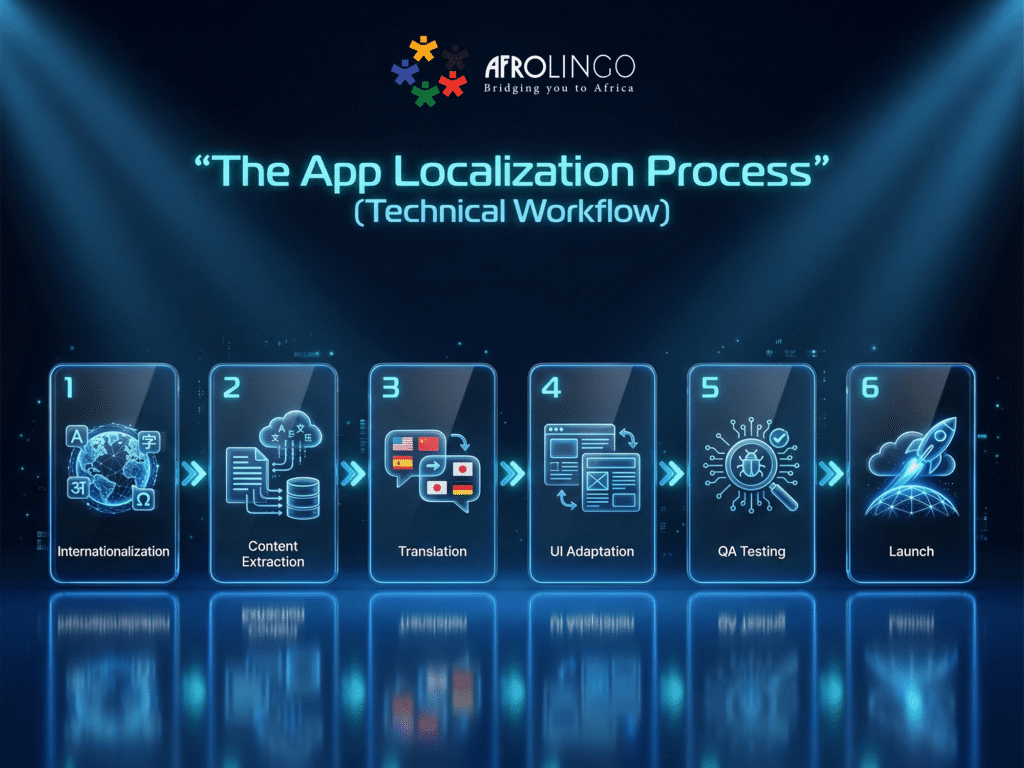
Internationalization: Preparing Your Codebase
Before you can localize anything, you’ve got to internationalize. Basically, this means building your app to support multiple languages from day one, even if you’re only launching in one market initially.
Design your database schema to handle different character sets and text lengths. German translations typically run 30% longer than English text, and Arabic reads right-to-left. Your UI needs to flex and adapt to these variations without everything breaking.
Managing File Formats and Content
Most mobile app localization projects use standard file formats like XLIFF, JSON, or platform-specific ones (strings.xml for Android, .strings for iOS). These formats keep your translatable content organized and maintain structure throughout the localization management process.
Set up clear naming conventions for your resource files from the start. Use ISO 639-1 language codes (en, fr, sw, ar) combined with ISO 3166 country codes (US, NG, KE, EG) for specific regional variants. This standardization keeps things from getting messy as your localized versions multiply.
Localizing App UI Elements and Icons
Visual elements need just as much love as text. Icons that seem universal? They often mean totally different things across cultures. A shopping cart icon works pretty much everywhere, but a mailbox icon styled after American mailboxes might confuse users in markets where mailboxes look completely different.
Colors carry serious cultural weight, too. Red means danger in Western contexts but represents luck and celebration in many Asian markets. White symbolizes purity at European weddings but mourning in several African cultures. You’ll want to review your entire color palette through a cultural lens for each target market.
Images with people need extra careful consideration. Stock photos of obviously Western settings? They’ll alienate African users whenever you can, create region-specific visual assets that actually reflect your target audience’s reality. This investment shows respect and authenticity…and users notice!
Adapting Functional Elements
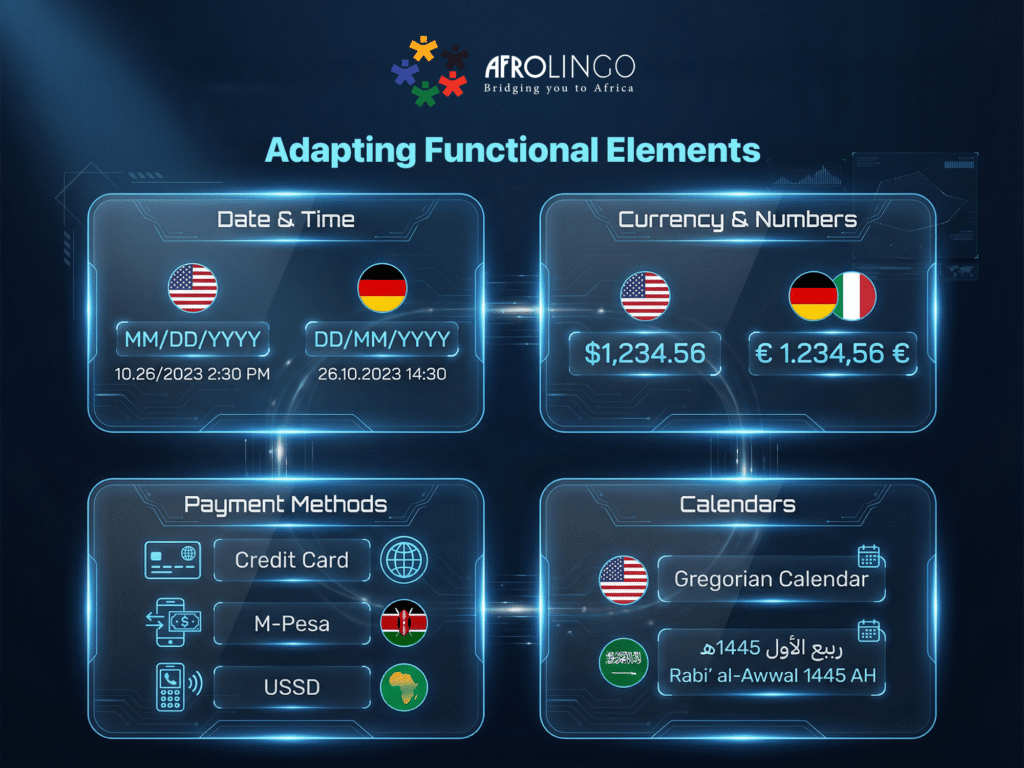
Technical localization extends way beyond what most teams think about initially:
· Currency and Payment Systems: Integrate local payment methods that your global audience actually uses. M-Pesa dominates mobile payments in Kenya and Tanzania. Nigerian users expect bank transfers and USSD options. Do your homework on payment preferences for each market.
· Dates, Times, and Numbers: Format these automatically according to local conventions. Handle different calendar systems where they’re relevant; Islamic countries may need Hijri calendar support alongside Gregorian dates.
· Legal and Regulatory Compliance: Privacy policies, terms of service, and data handling all comply with local regulations. South Africa’s Protection of Personal Information Act (POPIA) has specific requirements that are different from Nigeria’s NDPR or Kenya’s Data Protection Act.
App Store Optimization for Each Market
Your app store listings are often a user’s first impression in new markets, making them absolutely critical pieces of the localization process. Beyond just translating your website or app description, you need to research what actual users in target markets are searching for.
Keyword behavior varies massively by region. Users in Lagos might search “money transfer app”, while Nairobi users look for “send money Kenya.” Your localized app store listings should mirror these search patterns to maximize discoverability.
Create region-specific screenshots showing relevant use cases. An Ethiopian user wants to see how your app handles Birr currency and integrates with local services, not Dollar-based examples from your US version.
Quality Assurance and Launch

Translation errors in live apps don’t just embarrass brands; they actively frustrate users and kill conversions. Solid QA catches these problems before they reach your global audience.
Linguistic Quality Assurance: Native speakers must review every translated element in context. Words that work perfectly in isolation often fall flat when users encounter them in your app’s actual interface. Set up a three-stage review process: translation, editing, and proofreading by different linguists. This layered approach catches errors and keeps things consistent across your entire localized product.
Functional Testing Across Locales: Test every feature in every language. Does the payment flow work with all supported currencies? Do date pickers display correctly for different calendar formats? Does text fit within UI elements at all supported text sizes?
Cultural Validation: Beyond getting the language right, verify cultural appropriateness. Bring in focus groups from target markets to review your localized app before launch. They’ll spot cultural missteps that non-native consultants miss, subtle issues with imagery, tone, or assumed knowledge that can push users away.
Staged Rollout and Monitoring: Resist the urge to launch in all target markets at once. Start with one or two priority markets where you’ve done your deepest research. Watch your key metrics during initial launches: download rates, user engagement, conversion rates, and user reviews. Make it easy for users to report localization issues and go through reviews systematically across all versions. If multiple users call out confusing navigation terms or problematic translations, fix those issues immediately.
Continuous Improvement and Scaling: Your localized product needs ongoing maintenance. When you add features to your core app, those features need immediate localization for all supported markets. Update translations based on user feedback and how language evolves. Review and refresh your translations at least once a year.
Track performance metrics separately for each localized version: downloads by region, user engagement across languages, conversion rates, app store rankings, and support ticket volume. Compare these against your pre-localization baseline and competitors.
Conclusion
The app localization process demands real resources, careful planning, and ongoing commitment. But for businesses ready to expand beyond their home turf, localization unlocks growth opportunities that monolingual apps simply can’t touch.
Ready to localize your app for African and global markets? Afrolingo‘s team of localization experts specializes in bridging cultural and linguistic gaps for mobile applications. Hit us up to discuss your app localization strategy and get a customized quote for your target markets.