Skip to content


Nowadays, the most common myth is that AI will replace most of the operational roles; however, in localization project management, the opposite is true. The role is evolving into something far more strategic.
As the localization industry continues to grow, project managers are moving beyond schedules and task lists. AI is refocusing the role on smarter decisions that combine technology with cultural insight to guide brands across markets.
In this blog, we’ll break down how localization management is shifting from managing files to shaping global growth.
The Traditional View of Project Management Localization
Before AI, localization was a discipline of high-volume logistics. The Localization Project Manager (LPM) wasn’t a strategist but a high-stakes coordinator, juggling teams, vendors, translators, and reviewers across the localization market.
LPM does not write the code or translate the text. Instead, they build the pipeline. They extract content from developers, select the right linguists, ensure the tone is correct, manage the budget, resolve technical issues in the text files, and deliver the final version back to the client.
In other words, they act as the “grand maestro” of content that keeps every piece in sync, yet these operational demands leave little room to influence strategy or business outcomes.
The Role of the “Manual Orchestrator”
Before automated orchestration, adding a new language to a project meant adding layers of complexity to the localization strategy. For translation project managers, days were filled with repetitive workflows, turning the process of scaling into an uphill battle.
Their daily responsibilities included:
- Project Coordination: Managing timelines, resources, and deliverables across multiple languages.
- Vendor Oversight: Ensuring translators, reviewers, and agencies met quality and deadlines.
- Budget and Resource Tracking: Monitoring costs and resource allocation, often via spreadsheets rather than real-time dashboards.
- Logistical Routing: Extracting content from repositories and distributing hand-off packages to external partners.
- Technical Interpretation: Bridging “dev-speak” (technical code) and “human-speak” (cultural context) so team members can collaborate effectively and execute tasks without confusion.
- Quality Assurance: Maintaining consistency through glossaries, style guides, and manual reviews.
- Scope and Risk Management: Preventing delays, scope creep, and other risks.
- Problem-Solving: Handling issues reactively, from file errors to miscommunications.
- Managing Translation: Overseeing the end-to-end translation process to ensure content accuracy across languages.
- Manual Reporting: Collating data from multiple sources to create status reports for stakeholders.
The Traditional Challenges
Even with careful effort, the LPMs’ traditional localization workflows were prone to predictable breakdowns, often driven by two hidden factors that quietly undermined both profitability and brand trust.
- The Struggle with Scope Creep: Without real‑time tracking, projects expanded quietly as additional content, languages, or requirements were added late in the cycle. In localization, this usually happened when small, “off-book” content updates were added via email. These “ghost costs” weren’t discovered until the final invoice, often wiping out the project’s profit margins.
- The Quality Consistency Gap: Manual quality assurance is inherently reactive. Because checks happened at the end of the pipeline, errors were often caught too late. A classic example is the HSBC “Assume Nothing” campaign, which was mistranslated as “Do Nothing” in multiple markets. Because the manual workflow lacked early cultural visibility, the error went live, costing the bank $10 million to rebrand.
Traditional Pitfalls: The Scalability Wall
These persistent struggles with scope and quality weren’t just a once-in-a-lifetime problem; they were symptoms of a much larger structural failure.
This manual content management localization workflow eventually hit what industry veterans call the Scalability Wall. It’s a point where simply adding more people to a project no longer solves the problem; it only adds more complexity. When your process relies on human memory and manual repetition, growth becomes your biggest enemy.
Here are the three specific pitfalls that made sustainable growth nearly impossible in the pre-AI era:
Manual Workflow Fatigue:
Relying on human memory and manual hand-offs meant that as volume increased, so did the “Work About Work.” Reports show that teams using manual coordination can spend nearly 60 percent of their time on repetitive administrative tasks rather than meaningful project work.

The Spreadsheet Fragility:
Using Excel was the “Single Source of Truth,” which is a high-risk strategy. A single broken formula, a missed row in a manual hand-off, or an outdated version of a tracker could lead to an entire product launching with the wrong currency or corrupted character encoding in key markets like Japan or China.
Reactive Problem-Solving:
Traditional PMs lived in a state of “emergency management.” Instead of preventing risks, they were forced to solve them after they occurred. This reactive cycle meant that global launches were often delayed by weeks, missing critical seasonal opportunities or allowing competitors to capture the market first.

To make things clearer: when a localization team spends days manually reconciling spreadsheets for a 15-language launch, they hit a structural wall. This traditional LPMs manual orchestration cannot keep pace with international markets, creating a ceiling on global growth rather than driving strategic influence.
AI in Modern Translation and Localization Project Management
Industry research shows that over 40% of workers spend nearly a quarter of their week on repetitive tasks, time lost to coordination rather than impact.
Today, with the emergence of AI-powered Content Translation Management Systems, the job description of the Localization Project Manager has changed. We are no longer in an age where “knowing how to use the software” is enough; we are in an age where the software acts as a strategic partner.
AI-Powered TMS Platforms: The Strategic Pivot
AI-powered Content Translation Management Systems mark the evolution of localization from a manual chore into a high-speed, data-driven operation. Modern translation management systems (TMS) platforms replace fragmented, spreadsheet-based workflows with a centralized, intelligent orchestration layer, fundamentally re-engineering project planning.
These systems also improve translation quality. By storing and applying translation memories and glossaries, they maintain consistent terminology across technical, legal, or brand-critical content, reducing errors and costly rework.
Using AI-powered TMS frees localization project management from tactical coordination, allowing them to focus on decisions that truly matter and execute with impact:
Predictive Analytics: Moving from Reactive to Proactive
The most significant strategic shift is the use of predictive analytics to spot risks before they occur. Traditional PMs were reactive, solving crises as they arose. Today’s LPM leverages data-driven insights to protect the brand’s bottom line.
For example, if a language pair historically drops in quality by 15% during high-volume periods, AI flags this before work begins. The LPM can then adjust workflows, adding extra review layers or extending timelines—preventing errors before a single word is translated.
Continuous Localization: The “Always-On” Global Brand
In the AI era, the idea of a localization project with a fixed start and end date is becoming obsolete. Continuous localization allows translation to happen in real-time alongside product development.
Automated workflows leveraging translation memories eliminate redundant tasks and ensure consistency across markets. For instance, a single update to an English Owner’s Manual automatically propagates across all target languages, without requiring the PM to initiate dozens of separate projects.
Real-Time Stakeholder Visibility
Strategic impact depends on transparency. AI-powered content localization management systems provide live dashboards that give executives up-to-the-minute visibility into project health, delivery status, and ROI. This replaces static Excel reports, turning localization into a measurable, data-driven operation. LPMs can now provide the C-suite with a live “Global Readiness” score, transforming perception from a black-box cost center into a strategic business driver.
From Taskmaster to Strategist: The Essential Role of Today’s Translation and Localization Management
The AI revolution hasn’t replaced the localization project manager; it has elevated them, turning LPMs from task-focused coordinators into strategic contributors driving global growth.
Instead of asking, “Is the file ready?” they now ask, “Is this translation driving revenue?” their role spans strategic planning, data-driven decisions, and orchestration across markets, content types, and teams. Their success is no longer measured by word counts but by the ability to unlock new revenue streams, making the LPM a vital architect of global impact.
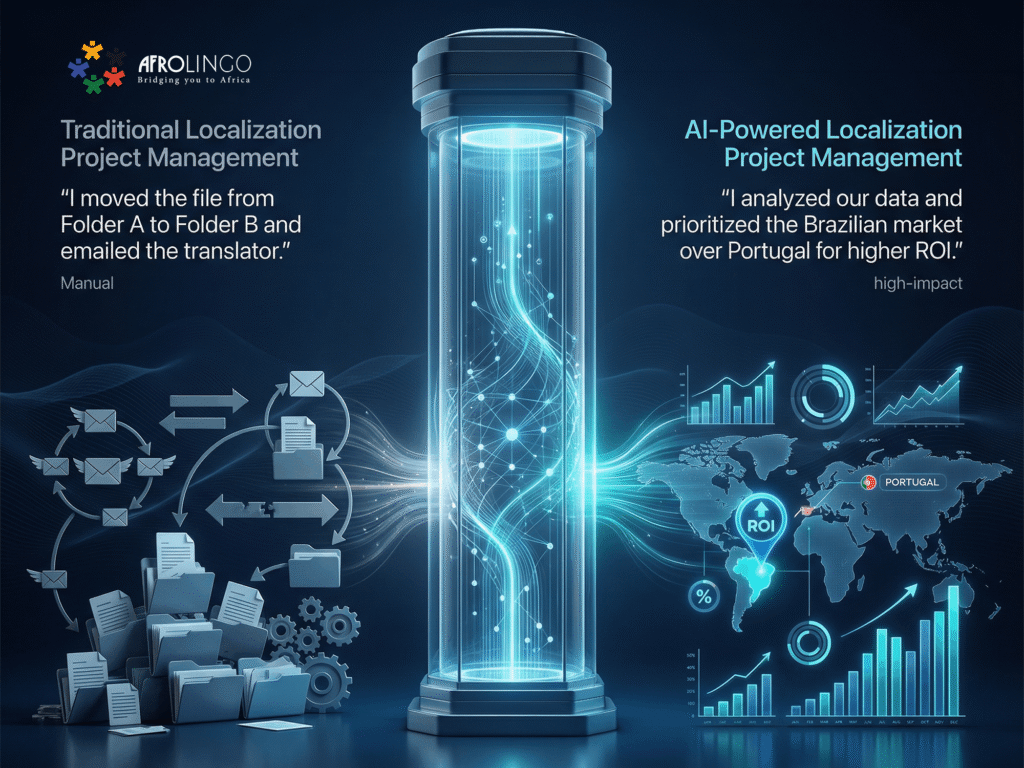
The Evolution of the Strategic Contributor
Proof of this evolution lies in the pivot from tactical execution to proactive leadership. By leveraging AI-powered systems to handle the “engine room” of logistics, the localization project manager now focuses on these main core pillars of strategic impact:
- Market-Led Strategic Planning: Managers are no longer downstream recipients of content; they are upstream consultants. By using market research to inform localization decisions, they determine which products require deep cultural transcreation and which can be scaled via “zero-touch” AI pipelines to maximize ROI.
- Data-Driven Decision Making: Today’s manager operates as a data scientist. With 24/7 access to dashboards tracking localization efforts, they move beyond reporting “status” to forecasting business outcomes. They interpret KPIs, such as market penetration and Net Promoter Scores, to advise leadership on which linguistic markets will deliver the highest ROI.
- High-Impact Stakeholder Management: The role is now the primary bridge between Product, Engineering, and the C-Suite. The manager’s job is to translate operational data into “business intelligence,” demonstrating how LPM’s efforts directly correlate with global user acquisition and retention.
- Balancing Speed, Quality, and Scalability
AI automates repetitive tasks, allowing LPMs to focus on high-value strategic decisions. By maintaining consistency across multiple languages while scaling output, LPMs ensure that localization not only meets deadlines but also strengthens brand presence worldwide.
- Multilingual Risk Management: In a multi-vendor, AI-heavy environment, the manager is the final safeguard. They manage the risks of cultural misalignment and AI “hallucinations,” ensuring that rapid scaling never compromises the brand’s local integrity or legal compliance.
- The Orchestrator of Global Growth: Balancing speed, quality, and scalability is a 2025 survival skill. And to scale efficiently, the LPM must pivot from task execution to system governance. This shift ensures brand resonance remains consistent even during massive volume spikes, transforming localization management into a high-yield business asset. As global AI infrastructure spending reaches$632 billion, organizations adopting this model are achieving up to a 514% ROI and a 60% reduction in administrative overhead, proving that once the “manual dam” is removed, localization becomes a primary engine for global revenue.
Your Key Takeaway
Localization no longer lives in spreadsheets. By offloading the logistical heavy lifting to AI, the localization project manager has undergone a permanent metamorphosis into a Global Growth Architect.
The LPM has successfully pivoted from a reactive, operational cost center into a high-leverage strategic engine. In this new era, translation and localization management are the primary drivers of global revenue, ensuring that brand quality and cultural resonance support long-term market expansion.
The AI revolution hasn’t replaced the manager; it has amplified their strategic value, shifting the focus from “processing files” to “architecting growth.”