Skip to content


People don’t buy what they don’t understand, and for any business to be understood, it needs to speak its targeted audience’s language….it needs website localization!
According to CSA Research, 76% of online shoppers prefer to buy products with information in their native language, and 40% will never buy from websites in other languages. Website localization is no longer an option; it is a deal breaker for any business expansion.
In this guide, we explore the website localization best practices and how they can take your business to the next level!
What is Website Localization?
Before diving into the website localization best practices, let’s clear up the difference between translation and localization.
Website translation and website localization are often used interchangeably, but they are distinct processes. Translation is the conversion of text from a source language to a target language. It focuses on the linguistic accuracy of the words.
Website localization (L10n), on the other hand, is the process of adapting an existing website to the local language and culture of a target market. It is about the “look and feel.” In other words, localization encompasses the entire user experience. It ensures that your website feels like it was created specifically for that user, rather than simply translated for them.
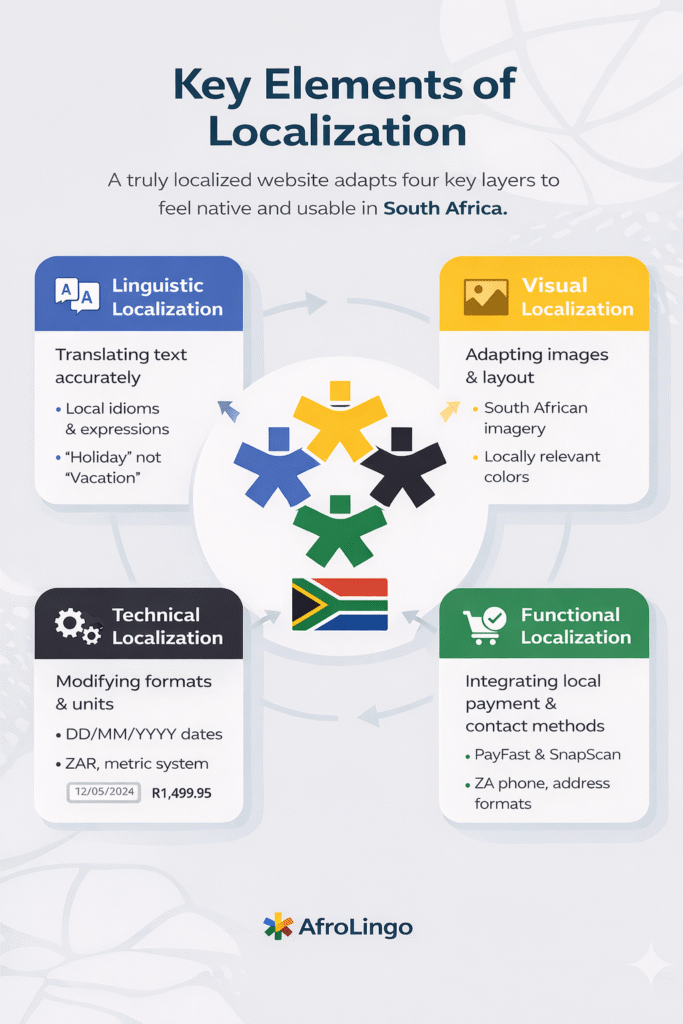
Key Elements of Localization
A fully localized site adapts four main layers:
- Linguistic: Translating text while accounting for local idioms (e.g., “vacation” in the US vs. “holiday” in the UK).
- Visual: Adapting images, colors, and layouts to suit local preferences. A hero image of a snowy Christmas works in Europe but feels alien to a user in Cape Town, where December is mid-summer.
- Technical: Modifying formats for dates (DD/MM/YYYY), currencies (ZAR, NGN, KES), and units of measure.
- Functional: Ensuring local payment gateways (like M-Pesa in Kenya or Fawry in Egypt) are integrated, and that contact information formats match local standards.
If you are asking yourself, why localize your website? The answer is simply because while translation makes your content readable, localization makes it relatable and sellable! So, what are the website localization best practices? Coming up next!
1. Strategic Planning: Market Research and Scope
The best starting point for any business is to understand the website localization process from a strategic standpoint. Rushing into translation without a roadmap is the most common cause of budget overruns.
- Conduct Deep Market Research
Don’t just pick a language; pick a market! Market research determines not only which languages to support but also the specific dialects required.
- Target Specific Locales: Portuguese in Lisbon is drastically different from Portuguese in Luanda or Maputo. Localization must account for these regional variances to build trust.
- Analyze Buying Habits: Does your target region prefer credit cards (US/UK) or mobile money solutions (common in East and West Africa)?
- Define Your Scope: Full vs. Partial Localization
You do not always need to localize every page; there are priorities!
- High Priority: Home page, legal terms, pricing, and high-converting landing pages.
- Low Priority: Old blog posts or hyper-local news relevant only to your HQ.
- Best Practice: Start with high-impact pages to test the market. If you are entering the Nigerian market, prioritize localized landing pages that speak directly to Lagos or Abuja consumers before translating your entire archive.
Action Item: Audit your Google Analytics traffic by “Location” and “Language.” Identify the top two regions visiting your site that currently have high bounce rates. These are your prime candidates for localization.
2. The Foundation: Website Internationalization Best Practices
You cannot paint a house that hasn’t been built, and the rule is the same with website localization! Website internationalization best practices include preparing your site’s architecture to handle different languages before any translation occurs.
- Separate Text from Images and Code
One of the most critical technical rules is to separate text from images and source code.
- The Problem: If you embed text directly into your HTML or PHP files, developers must manually edit code for every new language.
- The Solution: Use resource files (e.g., JSON, XML, or .PO files). This allows linguists to translate content without touching the codebase.
- Unicode (UTF-8) Standardization
Ensure your database and HTML headers are set to UTF-8. This encoding standard supports virtually every character set, from the Latin alphabet to Amharic script (Ethiopia) and Arabic. Without this, your localized content will appear as “” (tofu characters) or garbled text.
- Build in Localization Basics for Date and Currency
Hard-coding formats is a major technical aspect that you need to pay attention to.
- Dates: The US uses MM/DD/YYYY, while most of Africa and Europe use DD/MM/YYYY.
- Numbers: Some countries use commas as decimal separators (10,50) while others use periods (10.50).
- Currencies: Localize pricing not just by converting the exchange rate, but by displaying the correct currency symbol and position.
3. Design & UX: Adapting for Space and Culture
Keep your website design in mind from the start; a layout that looks perfect in English often breaks when translated into German, Arabic, or Swahili.
- Account for Text Expansion and Contraction
Languages take up different amounts of space.
- Expansion: German and French texts can expand by up to 30% compared to English. A button labeled “Submit” might fit perfectly, but the French equivalent “Soumettre” might break your navigation bar.
- Contraction: Asian languages may take up less horizontal space but require more vertical height for legibility.
Best Practice: Use responsive CSS grids that allow text containers to expand dynamically rather than fixing elements to specific pixel widths.
- Support RTL (Right-to-Left) Languages
If you are targeting North Africa or the Middle East (MENA), you must ascertain cultural adaptations for RTL languages like Arabic.
- Mirroring: It’s not just text alignment; the entire interface must flip. The logo moves to the right, and the navigation starts from the right.
- Icons: Directional icons (like “back” arrows) must also be reversed.
- Allow Users to Switch Between Languages
Never force a language based solely on IP address (Geoblocking). An Egyptian business traveler in London still wants to read your site in Arabic.
- Language Switching UI: Place a prominent language selector in the header or footer.
- Native Naming: List languages in their native format (e.g., “Français” instead of “French,” “العربية” instead of “Arabic”).
4. Multilingual SEO: Getting Found Globally
A localized website is useless if no one can find it; that’s why website localization best practices for SEO differ significantly from standard domestic SEO.
- Hreflang Tags are Non-Negotiable
To prevent Google from viewing your localized pages as duplicate content, you must implement hreflang tags. These tags tell search engines: “This version of the page is for French speakers in Senegal.”
- Example: <link rel=”alternate” hreflang=”fr-sn” href=”http://example.com/fr-sn/” />
- Local Keyword Research
Direct translation of keywords fails.
- Example: In the US, you might optimize for “Cell Phone.” In South Africa or Nigeria, the search volume is overwhelmingly for “Mobile Phone.”
- Strategy: Perform keyword research specifically for each target market using native SEO tools to capture the actual search intent.
- Optimize Meta Tags and URL Structure
- URLs: Use subdirectories (site.com/fr/) or subdomains (fr.site.com). Subdirectories are generally preferred for consolidating domain authority.
- Meta Tags: Optimize meta tags (Title and Description) not just for translation, but for local click-through incentives.
5. Workflow: Automation and Quality Assurance
Scalability is another barrier to consider; as you add languages, manual file transfers (emailing Word docs) become hard to manage.
- Adopt Continuous Localization
Modern web localization best practices rely on continuous localization. This integrates translation into your agile development cycle.
- Connectors: Use workflow automation tools and APIs to connect your CMS (WordPress, Drupal, Contentful) directly to your web localization service provider’s system.
- Benefit: When you update the English homepage, the system automatically triggers a translation request for the changes only.
- Localization Quality Assurance (LQA) Support
You can’t launch a website before testing, right? The best way to do this is by localization quality assurance, which involves two distinct phases:
- Linguistic Testing: A native speaker reviews the content for context, tone, and grammar.
- Functional Testing: Engineers check if the localized text broke the layout, if forms work with foreign characters, and if the checkout process accepts local addresses.
- Ascertain Cultural Adaptations in Media
Localized media must resonate with the targeted audience.
- Imagery: Ensure images reflect the local diversity. A website targeting Nairobi should feature Kenyan models and environments, not generic Western stock photos.
- Colors: Colors carry meaning. While red signals “danger” or “stop” in some contexts, it signifies luck and prosperity in others (like China) or may have political connotations in certain African nations.
Pro Tip: Account for translation and preferences regarding local customer support. If you localize your site into Swahili, ensure you have local customer support channels or a localized FAQ, as users will expect support in that language.
Conclusion
Website localization requires a lot of technical architecture, design flexibility, and deep cultural empathy. By following these website localization best practices, you move beyond simple translation to create a digital experience that feels native to every user, regardless of their location. That’s why you need to partner with a specialized web localization company.
Ready to internationalize your website?
Don’t let technical barriers stall your global growth. Contact Afrolingo today to discuss a localization strategy that aligns with your business goals and connects you with audiences across Africa and the world.